Why Waterless Personal Care Products Are Winning B2B Shelf Space
May 20, 2026
```html
What Counts as Waterless Personal Care Products and Why the Category Defies Easy Definition
Waterless personal care products sound straightforward until you try to buy them. I have sat across from suppliers who label a shampoo bar "waterless" even though the surfactant base was manufactured in a 70% water slurry, then dried. Is that waterless? The consumer never adds water, but the supply chain certainly did.
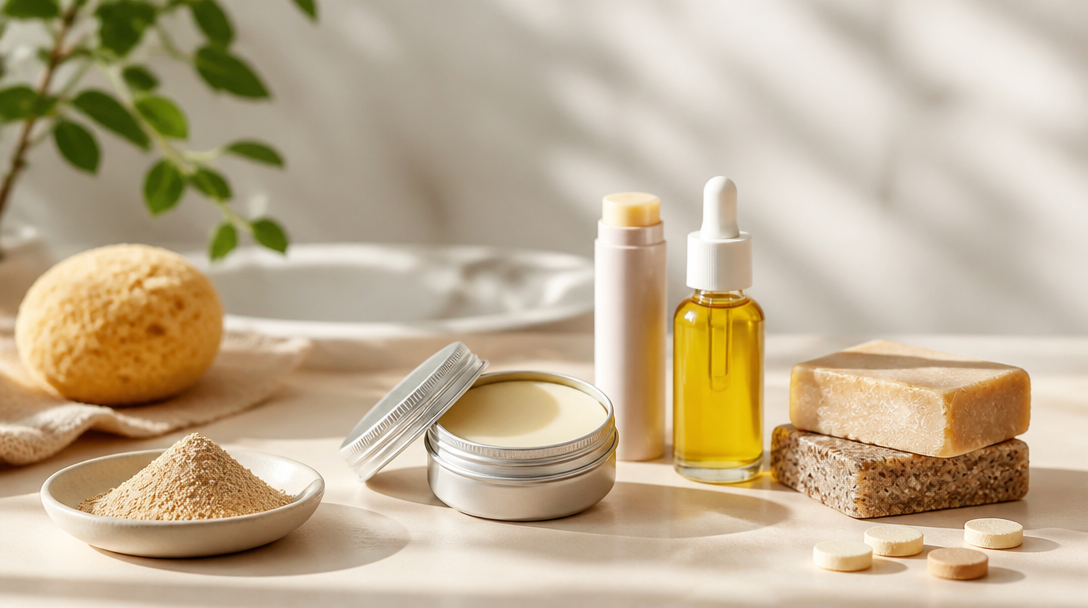
The category fragments into three distinct procurement buckets. Anhydrous formulations contain zero water in the finished product—think balms, oils, and wax-based products, though process water may still appear at earlier manufacturing stages. Water-activated formats—powders, tablets, concentrates—ship dry and require consumer-added water at point of use. Low-water products contain minimal water content, often under 5%, just enough to solubilize actives or enable processing. Each bucket carries different freight economics, stability profiles, and regulatory considerations. Buyers who do not interrogate where the water was removed in the value chain routinely overpay for marginal savings.
The definitional messiness matters for B2B shelf space because it directly impacts margin structure. A true anhydrous face oil ships without dilution; a water-activated shampoo powder ships at a fraction of finished liquid weight but requires consumer education and often custom packaging. Multiple market research firms project the waterless cosmetic market to reach well above USD 20B by the mid-2030s, though projections vary significantly depending on methodology and which product formats are included. Your P&L will differ based on which format you actually stock. I push suppliers to specify which format they are selling, not which marketing narrative they are riding.
Hair care currently leads waterless innovation in B2B channels because the use case is obvious: lathering already happens in wet conditions. Oral care and body care lag slightly, though powder-to-paste tooth cleaners and solid body wash formats are gaining retail placement. American distributors have been quicker to stock concentrated formats that reduce restock frequency and warehouse footprint, which helps explain North America's outsized share of this market segment.
Photo by Naturally Nude Artisanal on Unsplash
The Hidden Supply Chain Economics That Make Waterless Personal Care Products Profitable for Distributors
Freight is where waterless personal care products flip from sustainability story to balance sheet impact. Water constitutes 70–85% of conventional shampoo, conditioner, body wash, and liquid hand soap. You are paying to ship diluted product, paying again to warehouse it, and paying a third time when it leaks in transit and triggers replacement shipments.
Industry analysts consistently cite lower shipping weight as a key growth driver for the category. Let me translate that into terms a procurement director actually uses. Concentrated powder formats can reduce per-pallet weight by 80% or more compared to equivalent liquid loads, depending on formulation and packaging. That is not a marginal freight saving—it fundamentally restructures container utilization, especially for imports from Asian manufacturing hubs where ocean rates are calculated by cubic meter and weight class simultaneously.
The warehouse math compounds this. Waterless formats reduce required storage climate control—no freezing risk, less humidity sensitivity for sealed powders—and can stretch usable shelf life, potentially improving inventory turnover if sales velocity supports it. I have worked with distributors who moved from quarterly restock cycles on liquid body wash to semi-annual cycles on solid bars, freeing working capital and reducing stockout risk during supply chain disruptions.
Some market estimates—such as Technavio's projection of roughly USD 4.8B in incremental growth at approximately 8.5% CAGR from 2024 to 2029—may understate the B2B case because they weight consumer preference heavily. What we observe in manufacturing partnerships is different: buyers switch because their existing liquid suppliers keep raising prices to cover water treatment, wastewater compliance, and heavier packaging costs. Waterless becomes the path of least resistance even for buyers who do not prioritize sustainability positioning.
One caveat worth raising: powder and tablet formats can require capital investment in blending equipment or consumer-facing mixing vessels. Some buyers absorb this cost; others push it to retail partners. The total cost calculation must include who pays for the reconstitution infrastructure. I have seen category managers get burned assuming zero additional cost when their retail network demanded branded dispensers.
Formulation Science Behind Waterless Oral Care, Hair Care, and Body Care
Removing water is not the innovation—reformulating effectively without it is. The formulation science determines whether the product performs or dies on shelf.
In hair care, solid shampoo bars rely on sodium cocoyl isethionate (SCI) or sodium lauryl sulfoacetate (SLSA) as primary surfactants, bound into bars with fatty alcohols and butters. The manufacturing challenge is compression and hardness—too brittle, the bar crumbles in transit; too soft, it dissolves prematurely in humid bathrooms. The binding system matters more than the surfactant choice for B2B buyers, because breakage rates directly impact return allowance negotiations. I request compression test data and accelerated humidity stability results before placing orders.
Waterless oral care presents different chemistry. Powder-to-paste products typically use calcium carbonate or silica as gentle abrasives, combined with surfactants like sodium lauroyl sarcosinate and encapsulated flavor systems. The pH control is trickier in low-moisture environments because water ordinarily serves as a buffering and dissolution medium; some anhydrous formulations can trend acidic, which may raise questions about enamel safety claims. The regulatory boundary between cosmetic and therapeutic claims becomes acute in oral care, which is addressed in the next section.
Body care spans the widest range. Anhydrous body oils are genuinely simple—blend oils, add tocopherol for oxidation stability, package in oxygen-barrier materials. Solid body moisturizers require more sophistication: they must melt at skin temperature (approximately 32–35°C) but remain stable at warehouse temperatures that can exceed 40°C in summer container shipping. This means precise wax-to-oil ratio engineering, often with candelilla or carnauba waxes rather than cheaper beeswax variants that soften unpredictably.
The concentration advantage is real but has limits. A 50g shampoo bar typically delivers 80–100 washes, roughly equivalent to 800–1000ml of liquid product. But this assumes correct consumer usage—lathering in hands rather than rubbing directly on long hair, which depletes bars faster. Your marketing support materials, not just your formulation, determine whether the economics actually materialize for end users.
Shelf Stability and Regulatory Advantages of Waterless Personal Care Products
Buyers often obsess over preservative-free claims and miss the operational compliance benefits.
Water supports microbial life; remove it systematically and you transform your preservative strategy. Anhydrous products typically require no traditional water-phase preservatives—no parabens, no phenoxyethanol, no potassium sorbate. This matters for EU market access under Regulation (EC) No 1223/2009, where the restricted substance lists (Annexes II through VI) are extensive and evolving. Every preservative you eliminate is a regulatory risk you eliminate. The Product Information File becomes simpler. The safety assessment requires fewer exposure calculations. The CPNP notification remains mandatory, but the underlying documentation burden lightens measurably.
In the U.S., the FDA's FD&C Act and the Modernization of Cosmetics Regulation Act of 2022 (MoCRA) impose facility registration, product listing, GMP compliance, adverse event reporting, and mandatory recall authority. Waterless formats do not exempt you from MoCRA requirements, but they reduce the adverse event categories that typically trigger scrutiny—preservative reactions, microbial contamination, and water-phase separation. Compliance teams sometimes specifically seek anhydrous portfolios because their internal quality incident rates tend to drop proportionally.
Shelf stability extends beyond microbiology. Oxidation is the primary failure mode for anhydrous oils, but it is predictable and testable. Rancimat induction period testing provides concrete months-to-failure data. Contrast this with emulsion-based products where creaming, coalescence, and Ostwald ripening create multiple simultaneous failure vectors. The predictability matters for inventory planning and insurance valuations.
Health Canada's Cosmetic Regulations (C.R.C., c. 869) under the Food and Drugs Act, and Australia's Therapeutic Goods Act 1989, present similar patterns. Waterless products that remain clearly in cosmetic territory—no drug claims, no therapeutic positioning—face simpler border clearance and lower compliance overhead. The Australian TGA boundary is particularly relevant for oral care: claim "fresh breath" and you likely remain in cosmetic territory; claim "reduces plaque bacteria" and you may trigger therapeutic goods regulation. Waterless formulation does not change this boundary, but the reduced ingredient complexity can make claim substantiation documentation more straightforward.
One genuine limitation: powder formats that require consumer-added water reintroduce microbial risk at point of use. Your stability advantage holds through distribution but not necessarily through consumption. Packaging design—single-use sachets versus multi-dose jars—determines whether this risk reemerges. I specify individual sachets for institutional buyers (hotels, gyms, corporate accounts) where water quality at point of use is uncontrollable.
How to Vet Waterless Personal Care Product Claims: A Procurement Checklist
Supplier claims in this category are frequently inflated. Below is what experienced procurement teams actually request.
Water content specification by production stage. Not simply "waterless"—request the formulation water percentage at bulk manufacturing, at filling, and at point of consumer use. Anything above 5% at bulk is not anhydrous in finished form; anything requiring consumer water addition should specify exact reconstitution ratios and water quality requirements.
Accelerated stability data. Real data: 40°C/75% RH for 6 months minimum, with viscosity (for low-water formats), hardness (for solids), or dissolution rate (for powders) measured at intervals. Not a marketing one-pager—actual lab reports with methodology and testing intervals.
Microbial testing for water-activated formats. Appropriate challenge testing (such as USP <51> Antimicrobial Effectiveness Testing or ISO 11930 equivalent) showing acceptable microbial limits after inoculation with specified organisms. This is non-negotiable for powders and tablets; the dry state is not automatically self-preserving if manufacturing introduced transient moisture.
Freight density calculation. Active ingredient delivered per cubic meter, per kilogram shipping weight, per pallet position. Compare directly against your incumbent liquid or emulsion product. Some "waterless" concentrates ship in bulky primary packaging that erodes freight savings.
Preservative system disclosure. For anhydrous products: confirm no water-phase preservatives required and specify the antioxidant system instead. For low-water products: identify every preservative and cross-check against EU Annex V, Health Canada's Cosmetic Ingredient Hotlist, and any retailer-specific restricted substance lists (e.g., Sephora Clean, Credo, Whole Foods Premium Body Care standards).
Consumer usage instructions and complaint history. Has this product been sold before? What is the return rate? What consumer complaints have been filed? MoCRA's adverse event reporting requirements will eventually make this data more accessible, but experienced suppliers should have it now.
Regulatory file status. For EU markets: confirm a Responsible Person has been appointed, CPNP notification is complete, and the Product Information File is available for audit. For U.S. markets: confirm facility registration and product listing under MoCRA. For Canada: confirm Cosmetic Notification Form filing. Vague assurances are automatic disqualifiers; the regulatory environment is too active for ambiguity.
Consumer Demand Signals That B2B Buyers Should Track for Waterless Personal Care Products
Industry forecasts from firms like Fortune Business Insights and Grand View Research embed consumer behavior assumptions that B2B buyers should verify independently. Three signals matter most.
First, category velocity in premium retail. Solid shampoo and conditioner bars have achieved placement in Target, Sephora, and Ulta at price points exceeding their liquid equivalents. Waterless is not trading down—it is trading up. Your margin structure can accommodate higher cost of goods if the retail price supports it. Multiple market analyses show North America as a leading growth region, consistent with this premiumization pattern.
Second, search trend granularity. "Waterless shampoo" and "shampoo bar" represent diverging search behaviors—the former signals problem-aware consumers seeking solutions, the latter signals solution-aware consumers comparing brands. The first group is larger and earlier in the purchase journey; products positioned to capture that initial search intent generate higher conversion rates at lower customer acquisition cost.
Third, institutional adoption. Hotels, airlines, and gym chains are moving toward solid and concentrated formats for cost, waste reduction, and branding reasons. This B2B-to-B2B channel does not appear prominently in consumer market projections but represents steady, contract-based volume that stabilizes demand forecasting. Distributors who can serve both retail and institutional channels from the same waterless SKU base gain meaningful operational leverage.
The gap between consumer awareness and consumer adoption remains the primary risk. Search interest does not automatically translate to repeat purchase. Products that fail on lather feel, rinsability, or fragrance intensity during first use rarely get a second chance. Sampling programs and trial-size formats are not optional for new market entrants—they are table stakes for building the repeat purchase behavior that justifies distribution investment.
This article is for informational purposes only. LLRNCARE makes no representations or warranties about the completeness, accuracy, or reliability of the information. Any reliance is at your own risk.
For professional dental advice, consult a qualified dental professional. For regulatory compliance, consult legal experts.
```