Enamel Repair Technology: How Hydroxyapatite and Bioactive Glass Save Sensitive Teeth
May 26, 2026
Introduction
According to the latest oral health research data, 94% of consumers admit to having oral health problems, with tooth sensitivity ranking among the top concerns. That sharp pain when hot, cold, sweet, or acidic foods touch your teeth not only affects your eating pleasure but may also indicate deeper oral health issues. Why do teeth become sensitive? The root cause often lies in enamel damage – once the outermost protective armor of teeth is compromised, dentin becomes exposed, and sensitivity problems follow. Traditional wisdom held that once enamel is lost, it cannot regenerate. However, modern oral care technology is challenging this belief. In 2024, two cutting-edge technologies – Hydroxyapatite (HAP) and Bioactive Glass – are bringing revolutionary breakthroughs to enamel repair. This article will deeply analyze how these new technologies save sensitive teeth from the source, providing you with scientific, practical oral care guidance.Part 1: Understanding Enamel – The "Armor" of Teeth
1.1 What is Enamel?
Enamel is the semi-transparent hard tissue covering the tooth surface, approximately 2-3mm thick, making it the hardest tissue in the human body. Its main component is 96% hydroxyapatite crystals, arranged in a tight, orderly pattern to form a powerful physical barrier. Enamel has no nerves or blood vessels and cannot self-repair once damaged, making its protection particularly precious.1.2 The Dangers of Enamel Damage
Enamel damage triggers a chain reaction:- Tooth Sensitivity: Dentin tubules become exposed, allowing external stimuli to directly transmit to the dental pulp nerve
- Tooth Discoloration: Dentin color shows through thinning enamel
- Increased Cavity Risk: Bacteria can more easily invade tooth structure
- Tooth Fragility: Teeth become prone to wear and fracture under chewing pressure
1.3 Common Causes of Enamel Damage
- Acidic Erosion: Carbonated drinks, fruit juices, wine, and other foods/drinks with pH below 5.5
- Mechanical Wear: Brushing too hard, using hard-bristled toothbrushes
- Acid Reflux: Long-term contact between stomach acid and tooth surfaces
- Improper Whitening Product Use: High-concentration whitening agents or overuse
- Aging: Natural physiological wear
Part 2: Limitations of Traditional Dental Care Methods
2.1 The Role and Limitations of Fluoride
Fluoride was one of the most important oral health discoveries of the 20th century. It promotes tooth remineralization, forming more acid-resistant fluorapatite. However, fluoride's primary function is to strengthen existing enamel – its repair capability for already-formed defects is limited.2.2 How Ordinary Sensitivity Toothpaste Works
Most sensitivity toothpastes on the market temporarily relieve sensitivity by blocking dentin tubules, using ingredients like potassium nitrate or strontium chloride. This approach treats symptoms, not the root cause and cannot repair the structural defects of enamel itself.2.3 Why New Technology is Needed
As understanding of enamel's microstructure deepens, scientists have discovered that biomimetic repair is the fundamental solution. In 2024, oral care is evolving from "symptom relief" to "structural repair."Part 3: Hydroxyapatite (HAP) – The Black Technology of Biomimetic Repair
Recommended: Electron microscope image showing HAP crystal structure
3.1 What is Hydroxyapatite?
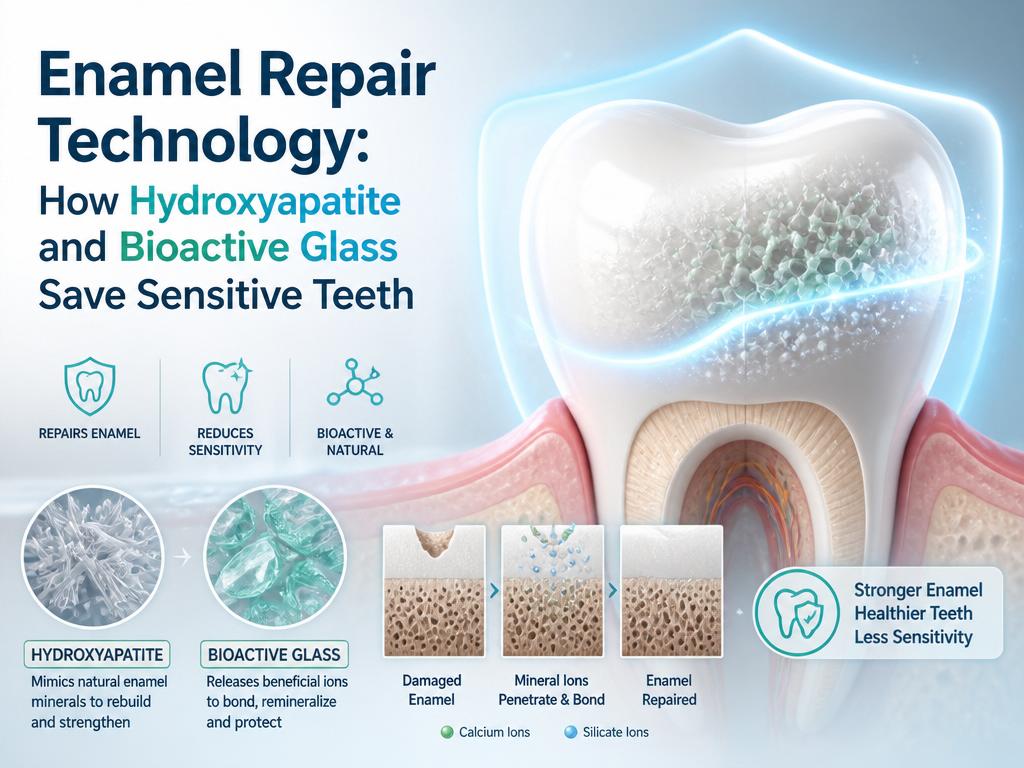
Hydroxyapatite is the natural main component of enamel. Modern technology can now synthesize nanoscale hydroxyapatite (n-HA) with particle sizes of only 20-100 nanometers – comparable to natural enamel crystal sizes – offering excellent biocompatibility.3.2 HAP's Repair Mechanism
Nanoscale hydroxyapatite repairs enamel through a triple mechanism:- Microscopic Filling: Nanoparticles penetrate microscopic defects in the enamel surface
- Crystal Growth: Induces new hydroxyapatite crystal growth at defect sites
- Surface Reconstruction: Forms a smooth, dense protective layer
3.3 Efficacy Validation of HAP
Clinical studies show that HAP-containing toothpastes outperform traditional fluoride toothpastes in remineralization effects:- After 4 weeks of use: Enamel microhardness increased by 27%
- Tooth sensitivity scores reduced by 65%
- Forms a 3-5 micron thick repair layer
3.4 Usage Recommendations for HAP-containing Products
When choosing HAP-containing products, note:- Concentration: Effective concentration typically 5-10%
- Particle Size: Nanoscale (<100nm) works best
- Formulation: Synergistic effects when used with fluoride
- Usage Frequency: Twice daily, continuous use for at least 4 weeks to see results
Part 4: Bioactive Glass – Dual Protection of Repair + Prevention
4.1 What is Bioactive Glass?
Bioactive glass represents innovative application of materials science in oral care, primarily composed of silicates, calcium salts, and phosphates. When exposed to saliva, it continuously releases calcium, phosphorus, and fluoride ions.4.2 Mechanism of Bioactive Glass
- Ion Release: Releases repair-needed ions in the oral environment
- Hydroxyapatite Formation: Deposits new crystals on enamel surface
- Antibacterial Action: Alkaline environment inhibits cariogenic bacteria growth
- Tubule Sealing: Effectively seals exposed dentin tubules
4.3 Additional Advantages of Bioactive Glass
- Long-lasting Protection: Repair effects can last up to 24 hours
- Antibacterial Properties: Reduces dental plaque formation
- pH Buffering: Neutralizes oral acidic environment
- Synergistic Effects: Enhances effects when combined with fluoride and HAP
4.4 Current Market Applications
In 2024, oral care products containing bioactive glass are experiencing rapid growth:- Toothpaste: Expanding from professional to consumer markets
- Mouthwash: Provides all-day protection
- Professional Care: Dental clinic repair materials
- Trend: Combination with probiotics, plant extracts
Part 5: Daily Care Recommendations – Protecting Enamel Health
5.1 Correct Brushing Technique
- Tool Selection: Soft-bristled toothbrush, appropriately sized brush head
- Pressure Control: 150-200g pressure (about the weight of an orange)
- Time & Frequency: Twice daily, 2 minutes each time
- Technical Points: Bass brushing technique, 45-degree angle for gumline cleaning
5.2 Dietary Habit Adjustments
- Acid Management: Rinse after acidic foods/drinks, wait 30 minutes before brushing
- Frequency Control: Reduce snacking frequency, consolidate eating times
- Protective Foods: Cheese, milk, and other high-calcium foods
- Hydration Habits: Drink plain water, avoid sugary beverages
5.3 Regular Check-ups
- Professional Cleaning: Remove tartar every 6 months
- Early Detection: Regular check-ups identify early enamel damage
- Personalized Advice: Dentists customize care plans based on individual situations
5.4 Proper Whitening Product Selection
- Avoid High Abrasion: RDA value (Relative Dentin Abrasion) < 100
- Contains Repair Ingredients: Choose whitening products containing HAP or bioactive glass
- Appropriate Concentration: At-home whitening agents concentration should not exceed 10%
- Cycle Control: Follow instructions, avoid overuse